
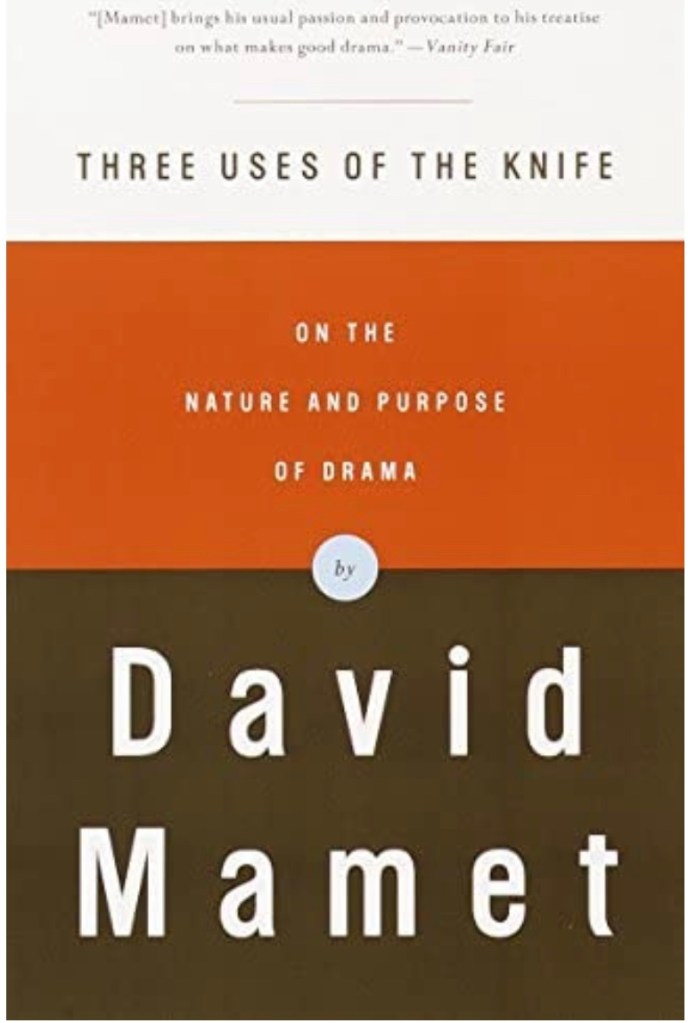
Es un ensayo breve pero enjundioso en el que Mamet desarrolla una teoría sobre el drama. Sostiene que tiene su origen en el hecho religioso, aunque está separado del mismo y tiene una existencia autónoma.
Sostiene, asimismo, que es un mecanismo que exige al receptor suspender su presunta racionalidad para que el drama opere.
Lo distingue, también, de la publicidad, que consiste en convencer a la audiencia de las bondades de un producto o servicio, que si realmente fuera necesario, no necesitaría un presupuesto de marketing.
En fin, a pesar de la brevedad, Mamet se despacha a gusto. Hace poco le entrevistaban en el Guardian. Tiene pinta de ser un señor al que ya le importa poco lo que puedan decir de él, si no, es difícil de entender un discurso tan libérrimo y absolutamente contrario a la corrección y dogma contemporáneo.
* * *
A one-hour flying visit to the Louvre is not an experience of Art (it barely even qualifies as «Art Appreciation», that scholastic nonsense of my youth). Now consider a museum with millions of «experiences» and those not masterpieces but advertisements. That is what we find on the seven hundred channels of video.
What right-thinking individual would spend hours, hours every evening, watching advertisements? Is it not clear that a product which must spend fortunes drawing attention to itself is probably not one we need?
In watching the television, in buying the product, we endorse the expenditure, we silently worship the idea of wealth, the idea of a state beyond strife–like the commoner who is unable to stop calling the duchess «My Lady.»
We will not encounter art in information any more than we will find love in the arms of a prostitute. And we know it. Information, the destructive countervailing force, travels under the mantle of art, or its more humble simulacrum, entertainment, as rapine and pillage go by the name Lebensraum or Manifest Destiny or the Monroe Doctrine.
We are, in the grip of this phenomenon, entering a new dark age. The information age is centralizing knowledge, rendering it liable to despotic control. We can write letters and deliver them by hand. If, however, we comunicate only over the phone lines, the flip of one centralized switch renders us isolated.
Similarly, if «information» is centralized in government-controlled «computer banks,» liable to power outage or any electronic mishap, might one not intuit that, yet again, the culture is voting for/being impelled explain their power over us by fervently advocating them, by defining their unquestionable, irresistible power as financial cornucopia and, by extension, as «good.»
In entertainment, we, as a culture, change from communicants to consumers. We become like the terrible supermarket test groups so beloved of the Hollywood minds: empowered judges, accountable to no one, passing on each moment of each presentation–thumbs up or thumbs down.
We publish the grosses of motion pictures as news.
Might we not next publish the current quote of paintings, to assure us of our correctness in granting them a moment of our time? To a certain extent, we already do this by sticking them in a museum.
The demand of immediate gratification is death for any art which takes place over time. That the audience be teased, disappointed, reassured, frightened, and finally freed is the essence of dramatic/musical form. It has to take place over time, and it must contain reversals. And the greater the art the more upsetting, provoking, «dramatic» those reversals are–it is only, and necessarily, garbage that «makes us feel good all the time.»
A G minor IIth means nothing in itself. It’s a jumble of notes. Even given a key of B flat, it means little more. We don’t know what it «means» until we hear its place in a particular composition.
Just so with the phrase «I love you,» just so with the «recognition scene» or the » death scene.» A temporal art demands the attention of the individual over time-an individual content to be piqued, to doubt, to be misled, to mourn, to, finally, consign herself to a process.
In this process the viewer goes through the same journey as the protagonist–which is, by the way, the same journey as the author.
Just as comercial pabulum reduces all of us (the creator, the «producer,» the viewer) to the status of consumer slaves, so dramatic art raises the creators and the viewers to the status of communicants. We who made it, formed it, saw it, went through something together, now we are veterans. Now we are friends.
How different from the drugged individuals sitting in front of flickering television screens, trying to explain the lunacy of their activity to themselves by calling it entertainment or «becoming informed.»
(pp. 58-61)
 Almayer’s Folly